


On Thursday, I had the privilege of chairing the HR Committee meeting where we reviewed our public safety compensation study and discussed how we must move forward. You can watch the full meeting here: HR Committee Meeting – September 18, 2025.
This is about more than wages on a spreadsheet. It’s about safety in our neighborhoods, schools, and businesses — and whether our first responders have the resources they need to keep pace with a rapidly changing Mount Pleasant.
As I’ve learned during my time on Council, it is Council that sets the direction and the level of service. As our Town Administrator reminded us in the meeting:
“The numbers we have are based on the level of service we provide, so if Council believes we need to increase our level of service in the field, then that would obviously require more firefighters and police officers.”
A Growing Town, Rising Demands
Mount Pleasant is not the quiet coastal town it once was. With nearly 95,000 residents across 52 square miles, our officers and firefighters are stretched thin. They are expected to be counselors, medics, legal interpreters, and protectors — often all in a single shift, under the glare of a camera and the weight of seconds.
If we want excellence, we must invest in it.
The Numbers Don’t Lie
Police Staffing
- Mount Pleasant Police Department: ~167 sworn officers for ~95,000 residents.
- Calls for service in 2024: 120,536.
- Ratio: ~1.73 officers per 1,000 residents.
- Regional peers: Charleston (2.9), Greenville (2.84), North Charleston (2.7).
➡️ Even reaching a modest baseline of 2.0 officers per 1,000 residents would require adding about 24 officers. That’s not politics — that’s math and public safety.
Fire Staffing
- Mount Pleasant Fire Department: 134 career personnel, 7 stations, 10,000+ calls per year.
- Ratio: ~1.38 firefighters per 1,000 residents.
- Regional peers: North Charleston (2.07), Greenville (1.96), Summerville (2.13).
➡️ A peer-like range of 1.9–2.1 per 1,000 suggests we are short 50–60 firefighters. Meeting NFPA 1710 standards — four-person companies, 17 personnel on a first alarm — will require a multi-year staffing plan.
What the Wage Study Shows
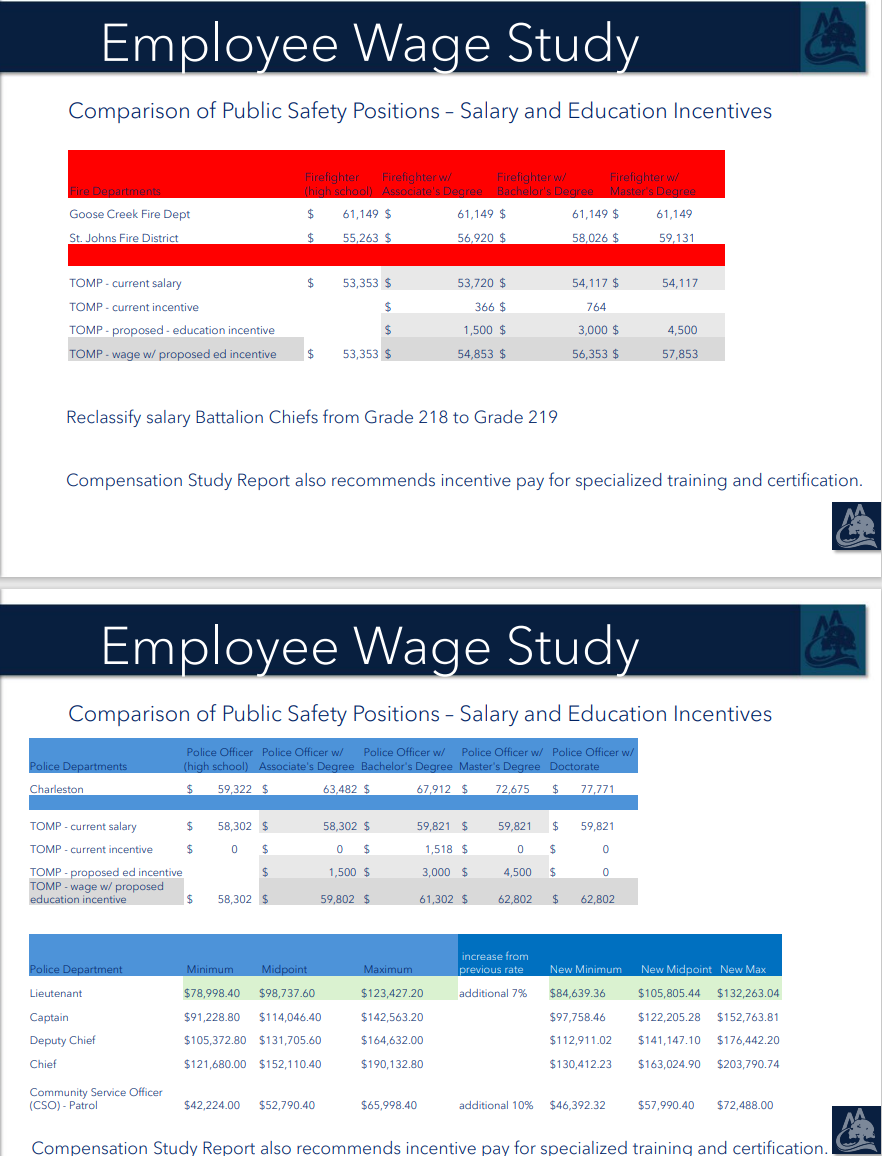
The Evergreen Wage Study confirms what our first responders already know: we are behind the market.
- Town of Mount Pleasant salaries lag peers by 8–10% at minimum and midpoint pay ranges.
- Firefighters and police officers are offered lower education incentives than surrounding jurisdictions (Mount Pleasant: $366–$1,518 vs. Charleston: 7% of base pay).
- Specialty incentives such as HAZMAT, marine team, SWAT, language skills, and instructor pay are nonexistent in Mount Pleasant, while they are standard in peer communities.
This means that not only do we start lower, but we also fail to reward the additional training and expertise that modern policing and firefighting demand.
Stewardship and Competitiveness
Being competitive doesn’t mean being reckless with taxpayer dollars. It means being good stewards of both public funds and public safety. It means recognizing that every dollar we fail to invest now could cost us later — in recruitment struggles, retention crises, slower response times, or even tragedies we might have prevented.
Evergreen has recommended:
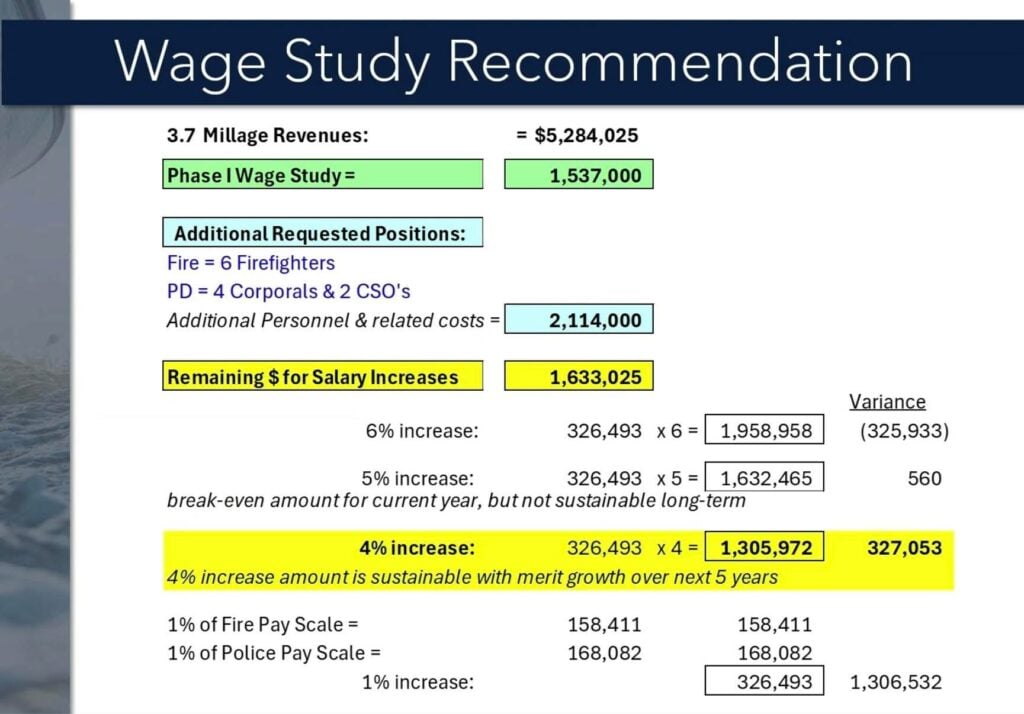
- A 6% structure-wide increase to close the gap with peers.
- Stronger education incentives: $1,500 (Associate’s), $3,000 (Bachelor’s), $4,500 (Master’s).
- Expanded specialty pay for advanced skills and assignments.
These are targeted, data-driven steps that balance fiscal responsibility with the clear need to strengthen our workforce.
Why Are There Two Votes on Millage Rates?
Every five years, state law requires South Carolina counties and municipalities to reassess property values. When this happens, the law also requires a rollback millage to be set — a recalculated rate designed to keep overall tax revenue about the same as the prior year, even though property values may have gone up.
That’s the first vote: to adopt the rollback millage.
But here’s the second part: state law then requires a separate, deliberate vote if a jurisdiction needs to increase millage above the rollback. This ensures transparency. Residents can see clearly that one act is to comply with reassessment law, and the other is a policy choice to raise revenue for critical services like police, fire, and infrastructure.
So, in a reassessment year, you’ll often see two steps:
- Rollback millage (required by law for revenue neutrality).
- Millage increase (a separate act to meet community needs such as public safety staffing).
And this is where the connection matters: if we don’t act on the second vote, we will not have the funding needed to make public safety pay competitive. Rolling back is required. Investing in our officers and firefighters is a choice — one we must make if we want to remain a safe, thriving community.
Mount Pleasant families expect accountability. If we are going to increase millage after the legally required rollback, it must be tied directly to essential services — starting with police and fire.
Because public safety isn’t negotiable. It’s the foundation of everything else.

Leave a Reply